
Why Buy a Foreclosure Property? Foreclosure properties can be excellent investments for…read more…

Distressed Property Trends and Insights
April 1, 2024
Foreclosure auction bidders continued to bid more conservatively in the fourth quarter of
2023, an indication that local community developers purchasing and rehabbing distressed
properties are still expecting a sluggish retail housing market in early 2024.
For the second consecutive quarter, buyers at foreclosure and bank-owned (REO) auctions
pulled back on the amount they were willing to pay relative to the after-repair value of
properties.
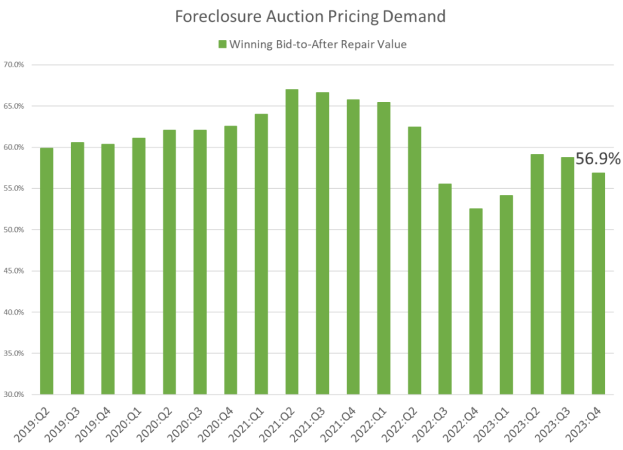
The average ratio of winning bid to after-repair value dropped to 56.9 percent in the fourth
quarter for foreclosure auctions, down from 58.8 percent in the previous quarter but still
higher than the 52.5 percent in the fourth quarter of 2022, when the housing market was
reeling from a flurry of rapid interest rate increases. The after-repair value is based on a
Automated Valuation Model (AVM) run at the time of foreclosure auction, and assumes a good,
fully repaired property condition.
The fourth quarter of 2023 was the second consecutive quarter with a quarterly decrease in
the price-to-value ratio at foreclosure auction following two consecutive quarterly
increases in the first half of 2023. A parallel pattern occurred for REO auctions over the
last four quarters.
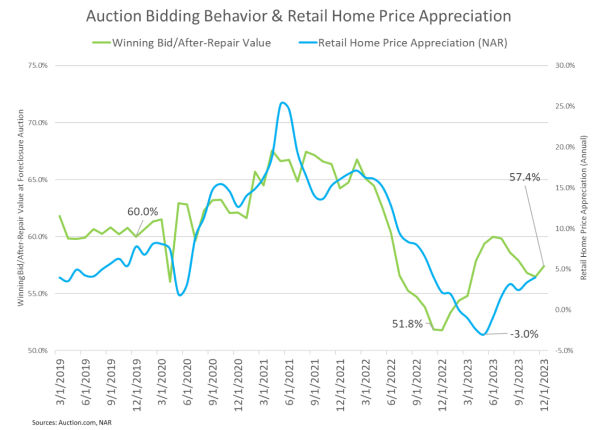
Masked by the quarterly numbers was a shift in bidding behavior in December that could be an
early sign local community developers expect a late-year drop in mortgage rates in 2023 to
provide the residential real estate market with a shot in the arm later in 2024. The average
ratio of winning bid to after-repair value at foreclosure auction in December was 57.4
percent, up from 56.5 percent in the previous month following five consecutive monthly
decreases.
The local community developers -who are the primary buyers at foreclosure auction are
typically reselling or renting back into their local retail housing market following about
six months of renovation. These local community developers are typically real estate
investors who buy 10 or fewer investment properties a year, all within their local market
that they know well and care about. The price these distressed properties are willing to pay
at auction provides a good forward-looking indicator of trends in retail home prices in the
coming six months.
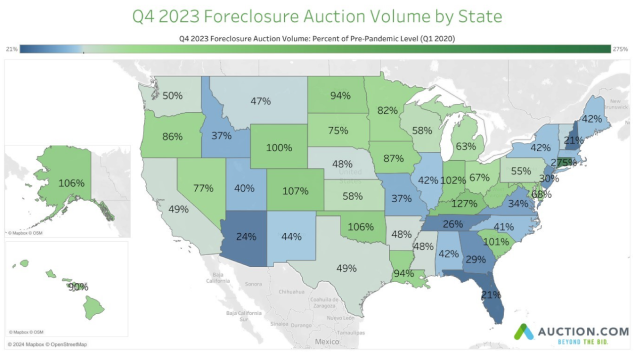
Supply of distressed properties brought to auction continued to be constrained in the fourth
quarter, with foreclosure auctions dropping below 50 percent of pre-pandemic levels for the
first time in two years and REO auctions dropping below 40 percent of pre-pandemic levels
for the first time in five quarters.
Eight states had foreclosure auction volume in Q4 2023 that registered above pre-pandemic
levels: Connecticut, Kentucky, Colorado, Oklahoma, Alaska, Indiana, South Carolina and
Wyoming.
Fourth quarter foreclosure auction volume was less than 40 percent of pre-pandemic levels in
nine states: New Hampshire, Florida, Arizona, Tennessee, Georgia, New Jersey, Virginia,
Idaho and Missouri.
States with the most foreclosure auction volume in Q4 2023 were Ohio, Texas, Illinois, New
York and Florida.
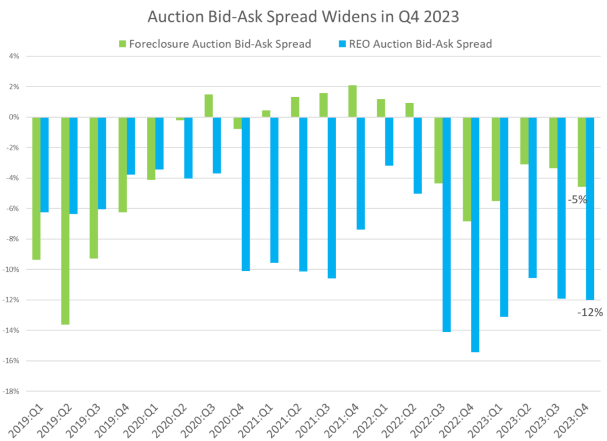
Demand for distressed properties slipped lower in the fourth quarter as the Bid-Ask spread
between what bidders were willing to pay (Bid) and seller pricing (Ask) widened.
The sales rate at foreclosure auction dropped by 3 points in the fourth quarter compared to
the previous quarter, although it was still up 6 points from the fourth quarter of 2022 — a
market that was reeling from skyrocketing mortgage rates in the second half of 2022.
Interest from potential bidders was still strong, with the average saves per property brought
to auction increasing 7 percent in the fourth quarter compared to the previous quarter and
up 29 percent from a year ago. But that interest didn’t translate into a higher sales rate,
likely because of a widening bid-ask spread between what bidders were willing to pay and
seller pricing. That bid-ask spread increased to 5 points in the fourth quarter, up from 3
points in the previous quarter.
The bid-ask spread for REO auctions also widened in the fourth quarter compared to the
previous quarter, albeit slightly, helping to chill bidding competition during the quarter.
The average number of bids per REO property brought to auction decreased 6 percent compared
the previous quarter and was down 4 percent from a year ago.
Foreclosure auction sales rates and REO bids per property in Q4 2023 were still elevated
relative to pre-pandemic levels, likely a function of low supply, but the pullback in these
demand metrics relative to the previous quarter indicates that local community developers
purchasing distressed properties are staying disciplined in their acquisition strategy,
sticking to the pricing that they believe reflects current and future market conditions.
Aside from the shift in December, the conservative bidding behavior in Q4 2023 indicates that
despite all the talk of a soft landing in 2024, local community developers are still wary
about the housing market in early 2024.
States with the biggest annual drop in price-to-value ratio at foreclosure auction included
Wyoming, Alaska, Montana, Delaware, Kentucky and North Carolina. The ratio dropped 5 points
or more from a year ago in all six of these states.
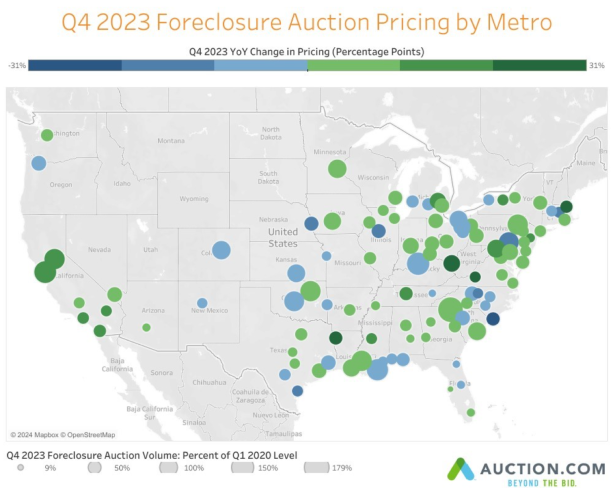
Among 102 metropolitan statistical areas analyzed in the data, those with the biggest annual
drop in price-to-value ratio at foreclosure auction were Myrtle Beach, South Carolina, York,
Pennsylvania, Omaha, Nebraska, Worcester, Massachusetts, Corpus Christi, Texas, Peoria,
Illinois, Greensboro, North Carolina, Gulfport, Mississippi, and Fort Smith, Arkansas. All
nine of these markets posted a drop of at least 10 points in the price-to-value ratio in the
fourth quarter of 2023 compared to a year ago.
Among larger markets, those posting a year-over-year drop in the price-to-value ratio
included Cleveland (down 1 point), New Orleans (down 7 points), Akron (down 3 points),
Oklahoma City (down 2 points), and San Antonio (down 5 points).
Why Buy a Foreclosure Property? Foreclosure properties can be excellent investments for…read more…