

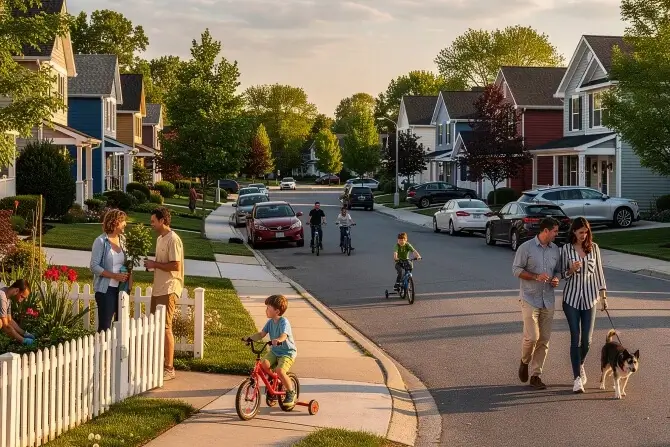
When distressed properties linger, recovery stalls. And delays raise neighborhood risks, slow progress, and erode confidence. Resolving inventory quickly and responsibly stabilizes housing markets.
That is where local community developers come in — the quiet engine that turns distressed housing back into productive homes.
Local community developers are mission-driven Auction.com buyers who purchase distressed properties locally, care deeply about the communities where they invest, and stabilize neighborhoods by returning distressed homes to productive use.
“My investing focuses on restoring distressed homes and putting them back into productive use, often giving families a second chance at homeownership or stability in neighborhoods that were declining,” said Auction.com buyer Wagas S. “By rehabbing properties thoughtfully, I help improve safety, property values, and pride in the community while creating fair opportunities for buyers and local contractors.”
They are not bulk acquirers. They are not distant capital. Instead, they are small-scale operators working on one property at a time — often within miles of where they live.
According to the 2026 Annual Buyer Insights Survey, 94% of respondents identified as either local community developers or owner-occupants, including 76% local community developers and 18% owner-occupants; 6% were other buyers.
Survey data highlights that local community developers consistently show three defining traits: operating locally, caring for the community, and stabilizing neighborhoods through redevelopment. We break down the results and impact below.
Local Community Developer Impact
- 398,000 homes renovated since 2015
- 168,000 renovated homes in underserved neighborhoods since 2015
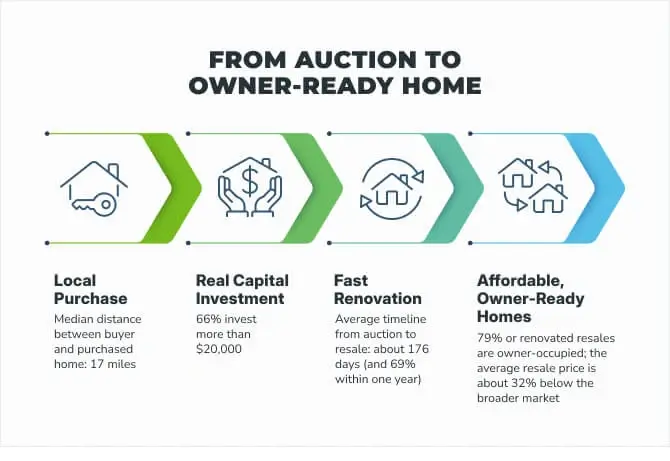
- 79% of renovated resales are now owner-occupied
- Average renovated resale price is about 32% below the broader market
- 69% of renovated resales were completed within one year
Operate Locally
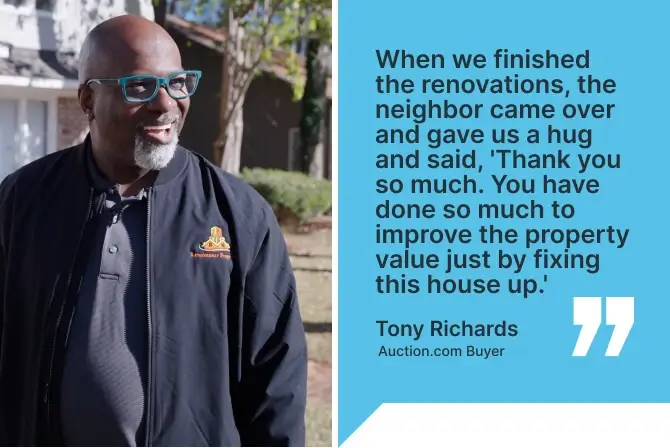
“When we finished the renovations, the neighbor came over and gave us a hug and said, ‘Thank you so much. You have done so much to improve the property value just by fixing this house up.'”
Tony Richards, an Auction.com buyer in Montgomery, Alabama, illustrates why local diligence matters: he purchased the property for about $71,000, invested $40,000 in rehab, and listed it for resale.
The survey data supports that hands-on operating profile. About 79% bought at least one property in 2025, 96% bought 10 or fewer properties. Looking ahead, 59% expect purchases to increase in 2026, while 33% expect purchases to remain about the same.
The model is deliberate: these buyers purchase properties individually, not in bulk. Transparent competition and one-by-one sales create an environment where local operators — those willing to carefully evaluate each asset — thrive. The transparent, property-by-property structure strengthens local diligence.
Geography reinforces the point. The median distance between buyers and purchased homes in 2025 was 17 miles overall — 15 miles for foreclosure auction purchases and 24 miles for REO auction purchases.
Local deal-finding is equally hands-on. When asked how they source off-market opportunities (other than through auctions), respondents most often cited:
- 56% local networks
- 44% public record data
- 32% driving neighborhoods
- 15% homeowners contacting them directly
Care for the Community
Local community developers invest not only for returns but also value safer blocks, livable homes, and helping local families put down roots.
The top three motivations of local community developers reflect that blend. They include building wealth for themselves and future generations, improving neighborhoods, and providing affordable housing and expanding homeownership (tied).
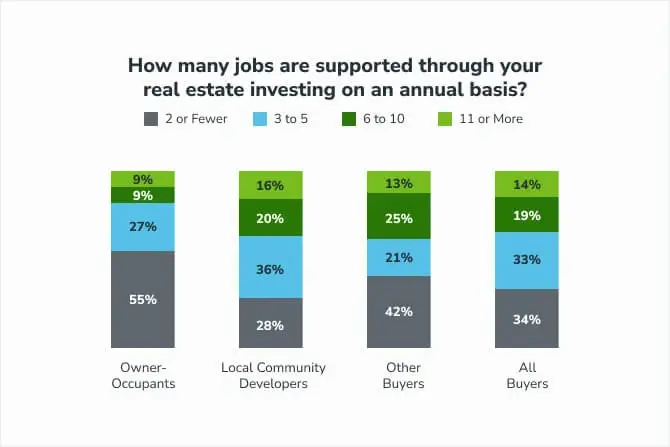
Local community developers also add to the workforce. One in five of them cite creating jobs.
“When buying an investment home, I hire individuals to make the repairs and updates,” said Auction.com buyer Kimberly M. “That gives jobs to those who need and are willing to work.”
Their strategies reflect their motivations. Most renovate and resell to owner-occupants (59%); others renovate and hold as rentals (33%). Another 5% focus on long-term holds, such as Opportunity Zone investments.
Observed outcomes reinforce those intentions. Since 2015, 214,000 renovated homes purchased through the marketplace have been resold, and 79% of those resales are now owner-occupied. In underserved neighborhoods, 75% of renovated resales are owner-occupied.
Affordability follows. The average renovated foreclosure resale price since 2015 was approximately $237,000 — about 32% below the average sale price of all homes sold during the same period. In underserved neighborhoods, the average resale price was $202,000. In Opportunity Zones, $185,000. Distressed pricing enables meaningful rehab while keeping resale prices attainable.
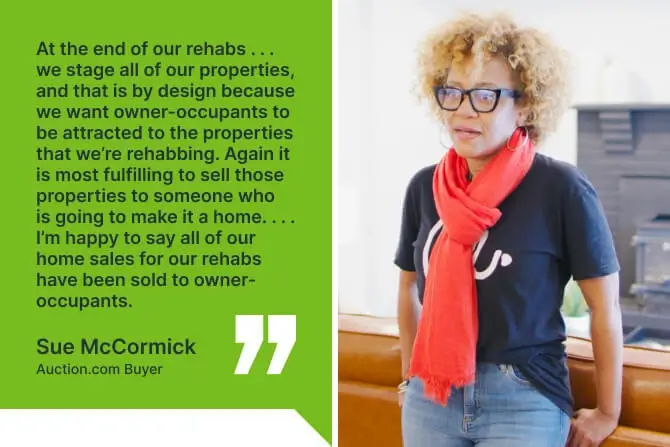
Sue McCormick, a local community developer in Dayton, Ohio, describes that end-state with clarity: “At the end of our rehabs . . . we stage all of our properties, and that is by design because we want owner-occupants to be attracted to the properties that we’re rehabbing. Again it is most fulfilling to sell those properties to someone who is going to make it a home. . . . I’m happy to say all of our home sales for our rehabs have been sold to owner-occupants.”
Stabilize and Develop Neighborhoods
Local community developers focus on addressing challenges through property renovation rather than holding assets.
“Well, our philosophy is fix it the first time,” said Tony Richards.
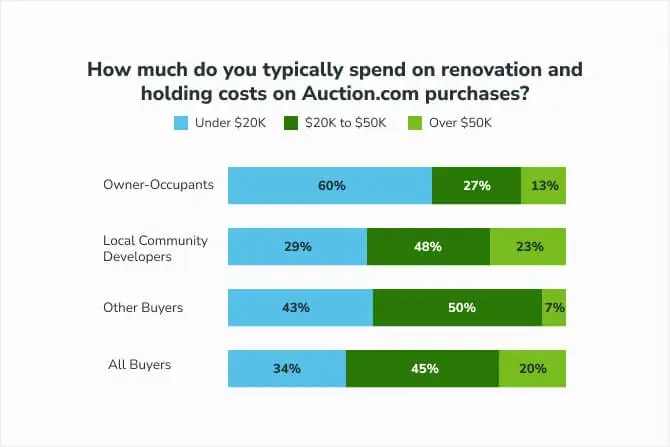
Renovation and holding costs are substantial for most Auction.com buyers. Nearly two-thirds of buyers (65%) spend $20,000 or more, with 45% spending between $20,000 and $50,000 and another 20% spending more than $50,000. About 35% spend under $20,000, reflecting a smaller share of lower-cost renovations. Overall, these results show that the vast majority of buyers are making meaningful capital investments in the properties they purchase.
Speed matters. Sixty-nine percent of renovated resales occur within one year of the auction purchase, with an average of 176 days from auction to resale. In underserved neighborhoods, the average timeline is approximately 175 days.
Predictable timelines and asset clarity enable rapid, responsible turnaround.
The result is measurable supply replenishment. Since 2015, buyers on the platform have renovated nearly 398,000 homes, including 168,000 in underserved neighborhoods and 27,000 in Opportunity Zones. Fifty-four percent of those renovated homes have been resold into the retail market.
Occupied Properties
The 2026 survey highlights an important segmentation point: 50% report not buying occupied properties. For those who do, many prioritize options intended to reduce disruption and create workable transitions — a graceful exit when that is the highest and best outcome, including transition assistance (cash for keys, relocation costs), lease-back, and buy-back.
Marketplace Structure Matters
The structure of a marketplace shapes who participates.
Individual property sales, transparent competition, and asset-level diligence create an environment that naturally attracts local operators. In 2025, at foreclosure auction sales, the average number of properties purchased per buyer was 1.6.
Competitive pricing reflects that dynamic. In 2025 foreclosure sales, the winning bid-to-unpaid loan balance ratio reached 98%, and the winning bid-to-estimated property value ratio was approximately 72%.
Institutional participation exists, but it accounts for only a small share of activity. The marketplace design — property-by-property sales, competitive bidding, and housing stock requiring meaningful renovation — naturally aligns with operators equipped to handle local-level complexity.
What This Means
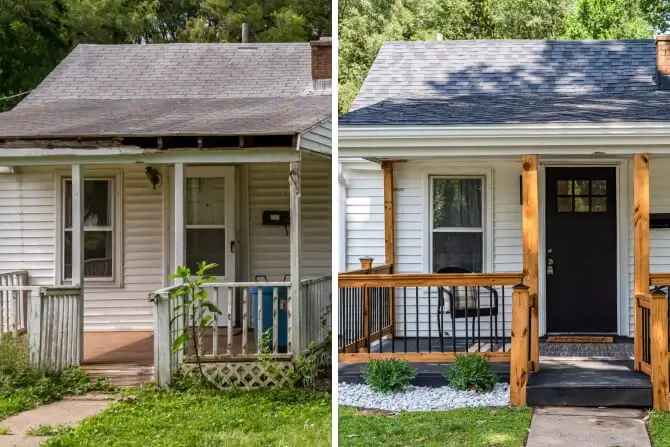
Distressed inventory requires local diligence and meaningful renovation investment, plus a clear end-state that returns housing to productive use through housing supply replenishment, affordability, and neighborhood stability.
Local community developers bring that combination. They invest close to home, put real capital into the work, and convert risk into habitability. When transparent sale structures pair with predictable processes and asset-level clarity, responsible transitions become more achievable, and housing supply replenishment accelerates.
“There is such a shortage of nicely renovated homes,” said Auction.com buyer Sharon R. “It’s exciting and fulfilling to offer renovated homes to families. They are so appreciative.”
Local community developers are the quiet engine of neighborhood recovery — and the Auction.com marketplace has empowered them for years.
Explore More Local Community Developer Stories.
- Taking Flight with Foreclosure Investing (June 2025): A military couple, a cross-country move, and their first foreclosure renovation.
- A Rapid and Responsible Return to Retail (Oct. 2025): A buyer’s fix-it-first philosophy.
- Buyers Giving Back: Sue McCormick Helps Improve Her Hometown (Oct. 2021): On location with Auction.com buyer Sue McCormick.
- Portrait of a Local Community Developer (Sept. 2022): Tony Tritt and Mary Robinson care about their products and the people who purchase them.
- How to Expand Opportunity Zones to Do the Most Good (July 2025): Outpacing policy with real neighborhood revitalization.
- The Renovation Ripple Effect in Underserved Neighborhoods (Aug. 2024): Auction.com and the transformation of the overlooked and left behind.