
What You’ll Learn
- What REO means and how bank-owned homes reach the market
- The due diligence steps that protect you before you bid
- How the auction process works from registration to the win
- What happens the day after you win
Bank-owned properties (also called REO properties) move through a more structured auction process than foreclosure sales, but buyers still need to prepare. The bank has usually worked to clear title and secure the property before listing, which makes REO auctions more approachable than live courthouse sales. However, title condition still varies from one listing to the next, and there can be situations where the title has disclosures or the foreclosure deed is not yet recorded. Buyers who do their due diligence on condition, meet the proof of funds deadline, and read the sale terms before bidding are usually in good shape going into the auction.
Three things to do before you bid on a bank-owned property:
- Open the property details page (the page that opens when you browse and click on properties on Auction.com) and note the deposit requirement, sale terms, and proof of funds deadline.
- Run a basic title review and, if available, arrange a property inspection.
- Set your highest and best bid based on estimated repair costs and comparable sales — not just the opening bid.
What Bank-Owned Means and How REO Properties Reach the Market
When a foreclosure property doesn’t sell — for example, because no buyer bids above the Estimated Credit Bid (the amount bidding must exceed to purchase a foreclosure property) — the lender takes ownership, and the property becomes REO, or Real Estate Owned.
That usually means the lender clears the title, secures the building against further damage, and handles basic cleanup before listing. In most cases, junior liens are extinguished during the foreclosure process, and the bank addresses remaining encumbrances before the sale. The result is a property that comes to market with cleaner ownership history than a live foreclosure — though that’s not a substitute for your own title review.
Most REO properties are listed through an online marketplace or asset management company rather than a local MLS. Many have been vacant for months, sometimes longer, by the time they hit the market. That vacancy period can affect condition in ways that photos don’t always capture.
Why Buyers Choose REO Properties
REO properties attract investors and owner-occupants for the same core reason: price. Properties that reverted to the bank after foreclosure often carry below-market price tags, particularly when condition issues are reflected in the opening bid. That discount is the trade-off for the as-is terms and the work required after closing.
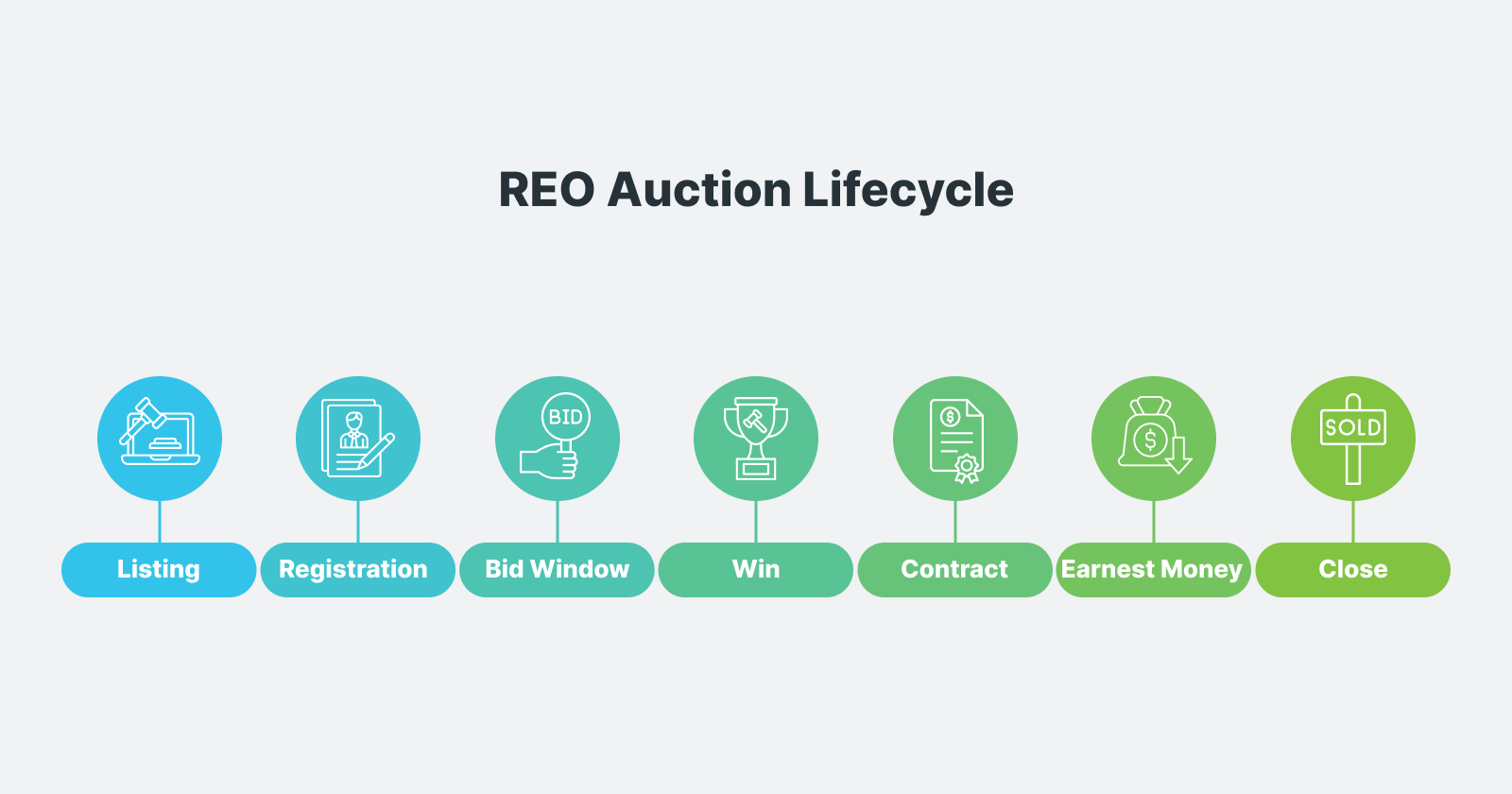
What makes REO auctions different from live foreclosure sales is the process. REO auctions typically run online over a set bidding window, with post-win steps that include a signed contract, earnest money, and a closing workflow. That process tends to look more like a traditional real estate transaction than a same-day courthouse sale, with more time between the win and the close.
It takes more preparation than a standard purchase, but the process is learnable. The math only works if your cost estimates are accurate. A price that looks like a bargain before you run repair numbers can look very different after. Buyers who build those numbers before auction day tend to bid with more confidence and walk away from deals that don’t pencil out, which is the discipline that makes REO investing work over time.
REO vs. Foreclosure vs. Private Seller
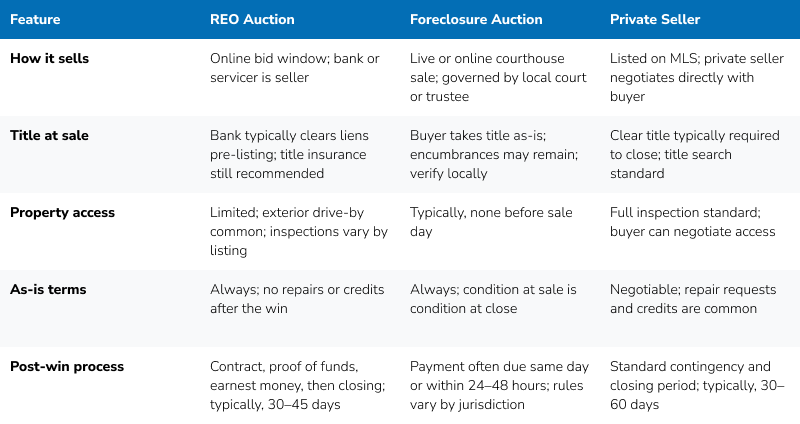
Requirements vary by listing, platform, and jurisdiction. Always read the posted sale terms before you bid.
Due Diligence Before You Bid on a Bank-Owned Property
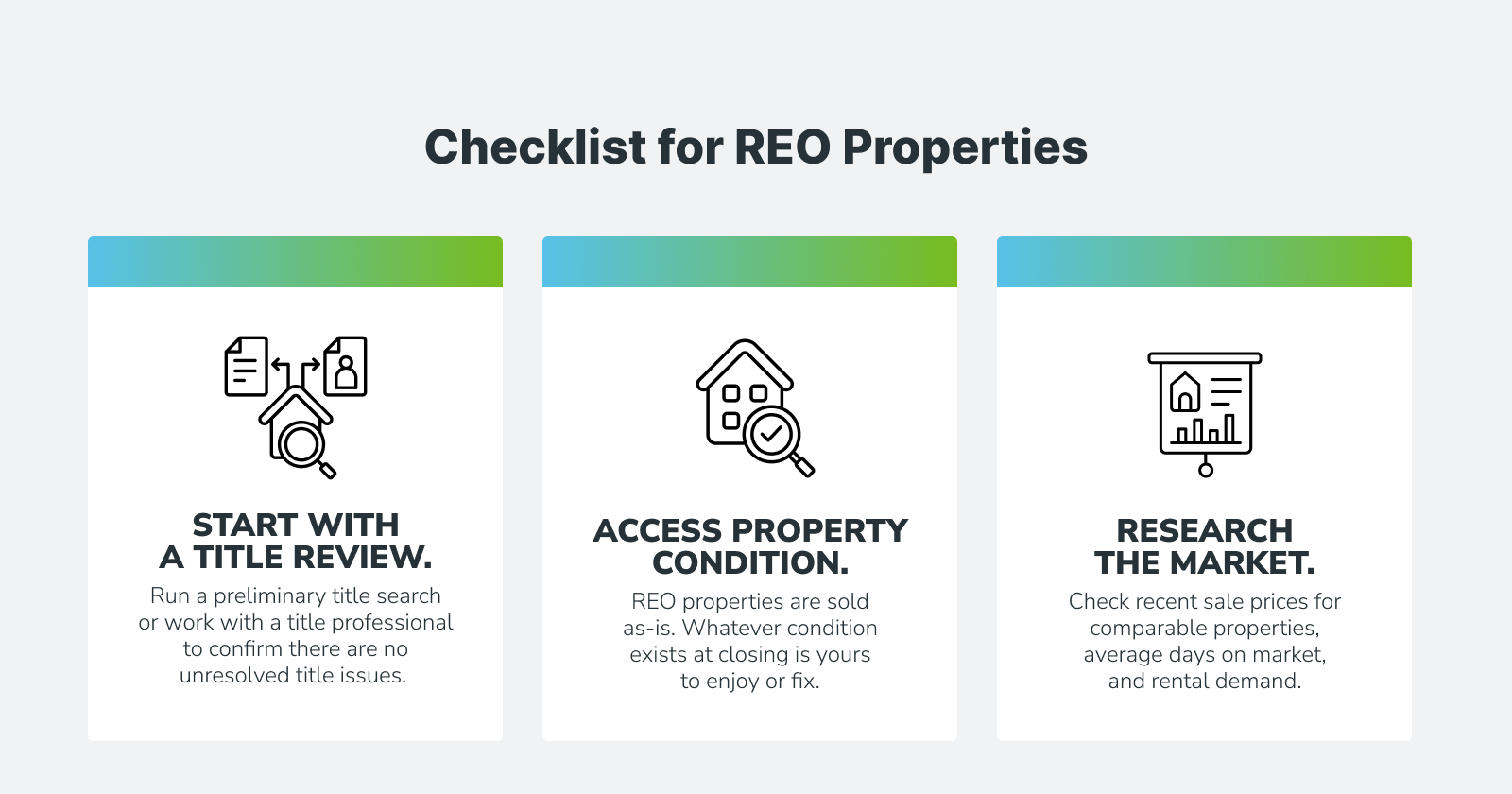
Your due diligence before bidding on an REO property has three parts: title, condition, and market. All three need attention before you set your maximum bid. Rushing any one of them is how buyers end up stuck with surprises they could have anticipated.
Start with a title review.
The bank typically works to clear title before listing an REO property. That process generally addresses junior liens and other claims from the foreclosure. But “typically” isn’t the same as “always,” and what’s been cleared can vary. Some listings include disclosures flagging a known title issue, and in some cases the foreclosure deed may not be recorded yet. Run a preliminary title search or work with a title professional to confirm there are no unresolved title issues.
The posted sale terms will also specify what title protection, if any, the seller is offering on that specific listing. Title insurance protects you against claims that surface after you close. Read the terms to understand what coverage is being offered before you assume a clean title is guaranteed.
That pre-listing work is a real buyer advantage over live foreclosure sales, where title cleanup happens after the fact — if it happens at all. Still, if you can’t get a clear read on the title status before auction day, you may want to wait for a listing where you can. A title issue discovered after the win is yours to resolve.
Assess property condition.
REO properties are sold as-is. Whatever condition exists at closing is yours to enjoy or fix. If a property inspection is available, take it. A licensed inspector experienced with distressed properties can estimate repair scope in a way that listing photos simply can’t.
If access is limited or an inspection isn’t offered, build a conservative contingency into your numbers. A property that looks structurally sound in the listing photos can carry deferred maintenance costs you won’t see until you’re inside: roof wear, HVAC age, and foundation issues. A low opening bid is a reason to look harder at repair costs, not a reason to move faster. When the numbers hold up after a thorough review, you’ll be able to bid with real confidence.
Research the neighborhood and market.
The property doesn’t exist in isolation. Check recent sale prices for comparable properties, average days on market, and rental demand if that’s your plan. Look for neighborhood-level factors that affect long-term value: employment shifts, school district changes, and planned development nearby.
Zoning matters too, especially if you have a specific use in mind. Short-term rental restrictions can significantly affect investor returns regardless of property condition. HUD’s homebuying resources
include useful guidance on evaluating neighborhoods and local market conditions.
How to determine your highest and best bid before the auction.
Your highest and best bid is a number you calculate before the auction opens, not a feeling you develop while bidding. The basic formula: take the after-repair value (ARV) based on comparable sales, subtract your estimated repair costs, then subtract the minimum profit margin you need the deal to make sense. What’s left is your ceiling.
Hypothetical example: Here’s how this works in practice.
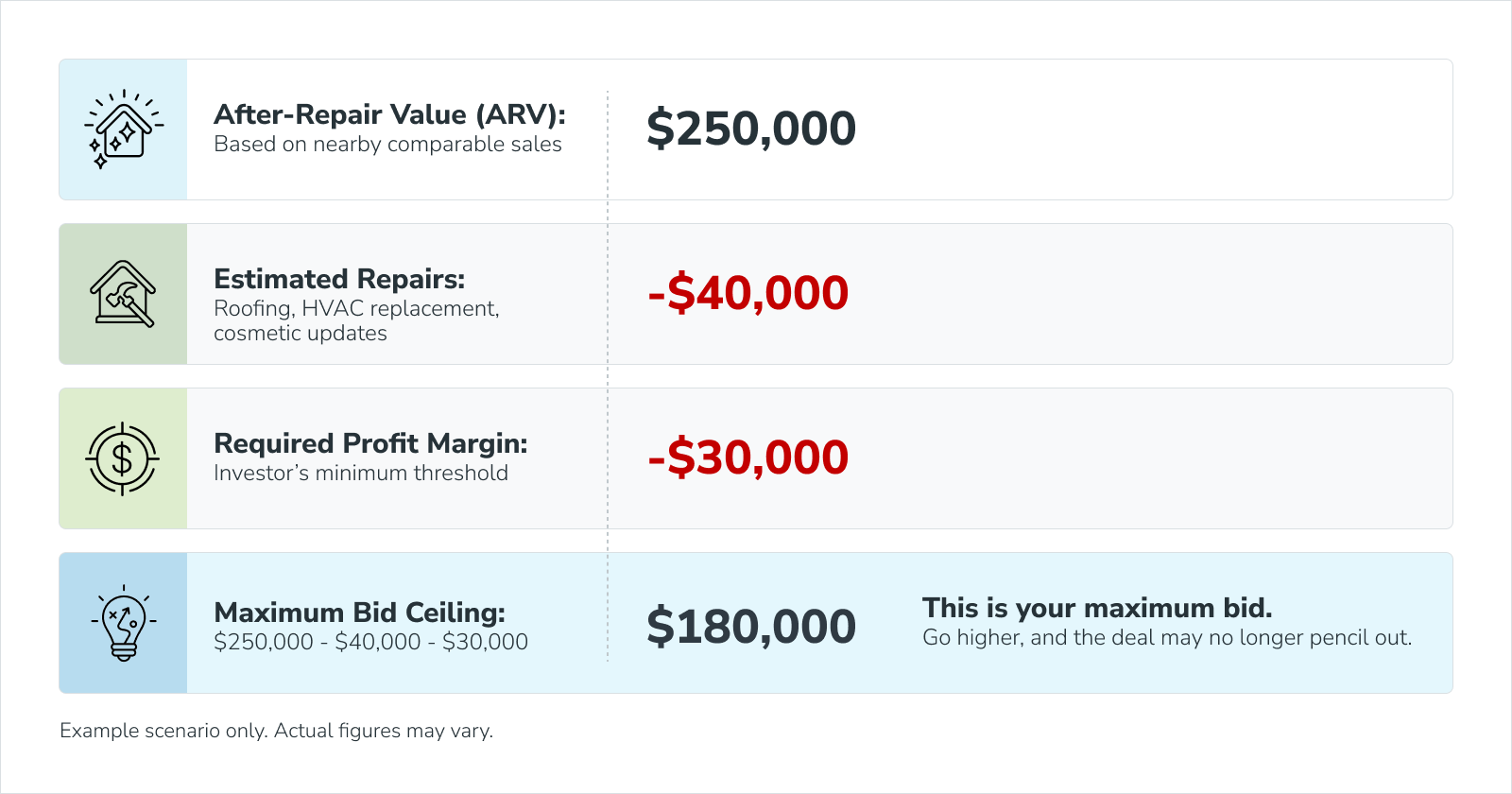
This formula applies to investor math. An owner-occupant buying a primary residence runs a different calculation: purchase price plus estimated repairs versus comparable home values in the neighborhood, with affordability as the ceiling rather than a profit target. The principle is the same: Know your number before the bidding window opens.
Steps: How to Buy an REO Property at Auction
Buying a bank-owned property at auction follows a clear sequence. Getting each step right is what leads to a smooth transaction. Buyers who work through this sequence before auction day are almost always the ones who close without a scramble.
Step 1: Find and filter REO listings.
Search for bank-owned properties using the property type filter on your chosen platform. Narrow by location, price range, and auction date, then scan several listings before going deep on any single property. Patterns in pricing, condition disclosures, and sale terms across multiple listings help you calibrate what’s realistic in that market. Auction.com lists thousands of REO properties nationwide and includes local comparables, auction alerts, and estimated rental values on each property details page.
Step 2: Read the property details page and posted sale terms.
Before you register or fund a deposit on any property, read the property details page from top to bottom. The sale terms contain the deposit amount, proof of funds requirements, accepted payment methods, and post-win deadlines. These rules are specific to each listing. Be sure not to carry assumptions from one auction into the next.
Step 3: Register and meet the deposit requirement.
Many online REO auctions require a registration deposit to access bidding. This is separate from earnest money: a bid-access step, not a down payment. Read the posted sale terms for refund eligibility and for the consequences if you win but don’t close.
That information differs by listing and by platform. Make sure you know it before your money moves.
Step 4: Prepare your proof of funds before auction day.
Have your bank statements, pre-approval letter, or equivalent. For REO auctions, proof of funds is typically submitted shortly after you win, not before. That timing is easy to misread: It doesn’t mean you can arrange the money after you win. The funds — or the financing behind them — need to be secured before you bid; only the documentation gets submitted afterward. Have your bank statements, pre-approval letter, or equivalent documentation ready before auction day, and proof of funds is typically required within 48 hours of winning the auction. If you’re financing the purchase, confirm your lender can meet the timeline posted in the sale terms before you bid.
If you’re financing the purchase, secure that financing before you bid, not after you win. Winning doesn’t open a window to go find a loan. Confirm that your lender is committed and can meet the timeline posted in the sale terms before you place a bid.
Step 5: Place your bid on auction day.
Log in before the bidding window opens and confirm your highest and best bid. This is the number you calculated in due diligence: ARV minus estimated repairs minus your required margin. Real-time competitive bidding moves fast, and bid increments can push the final price up quickly. Set that number before you log in.
Learn about Auction.com’s Max Bid feature, which automates the bidding process for you and ensures you never bid above your max.
Step 6: Complete your post-win requirements on time.
Once you win, your post-win checklist begins. It’s key to track your post-win tasks and timeline so you can complete each in a timely manner. Some of those tasks include countersigning the contract, uploading proof of funds, wiring earnest money, and completing any additional account steps. Missing one can delay or upset the transaction. Here’s how you stay on task and complete your post-win steps on time: Build a same-day action plan before you bid. Know what you’ll do in the first 24 hours after a win, who you’ll call, and what documentation you’ll move first. Buyers who prep these steps in advance can move through the post-win process smoothly.
What “As-Is” Means When the Seller Is a Bank
“As-is” means no repairs, no repair credits, and no renegotiation based on condition findings after the win. As-is doesn’t mean the house is in a horrible condition; it means you’re purchasing the property in whatever condition exists at closing, regardless of what turns up afterward.
Some REO listings, particularly those marketed to owner-occupants, may allow limited inspection periods or financing contingencies depending on the seller’s terms. That flexibility, when it exists, is worth factoring into which listings you prioritize. Always check the full listing terms carefully, because what you see on the property details page is what governs the sale.
If you can’t inspect the property, confirm the title status, or produce a defensible repair estimate, then those are legitimate reasons to reconsider the listing and explore other inventory for better opportunities that fit your goals. Please understand that if you fall out after winning the auction, you may be subject to losing your online bid deposit.
Bank-owned properties are one of the more accessible entry points into distressed-property buying, and buyers who’ve done their homework often find the process more manageable than it looked at first. The bank has done some of the groundwork — cleared the title and secured the property — but the due diligence on condition, market, and sale terms is yours to complete. Read the property details page before anything else. Know your numbers before auction day. And the moment you win, treat the post-win checklist as the transaction, because that’s exactly what it is.
Pull up two or three REO listings in your target area and open each property details page. Read the sale terms, note the deposit requirement and proof of funds deadline, and compare them side by side. This is your due diligence rehearsal — before real money is on the line. Save the listings that have clear terms and documented conditions. Skip the ones that don’t. Browse REO properties on Auction.com to get started.
Key Takeaways
- Bank-owned (REO) properties are assets the lender took possession of after foreclosure. The bank typically clears title and secures the property before listing.
- REO auctions usually run online with a post-win workflow: contract, proof of funds, earnest money, and close.
- As-is terms mean you carry condition risk. Due diligence on title, property, and market is your responsibility, not the bank’s.
- Read the property page and posted sale terms before you bid. Deposit rules, proof of funds deadlines, and post-win timelines are specific to each listing.
- Have your proof of funds documentation ready before auction day, not after the win.
- If you can’t verify condition, title, or repair costs on a specific property, consider exploring other properties that allow you to do so.
